Overview
OpenBind is generating large-scale, openly available datasets of protein–ligand structures and binding measurements to support the development and rigorous evaluation of computational methods for drug discovery. As part of this effort, we are excited to announce the first OpenBind blind challenge in partnership with OpenADMET and the ASAP Discovery Consortium.
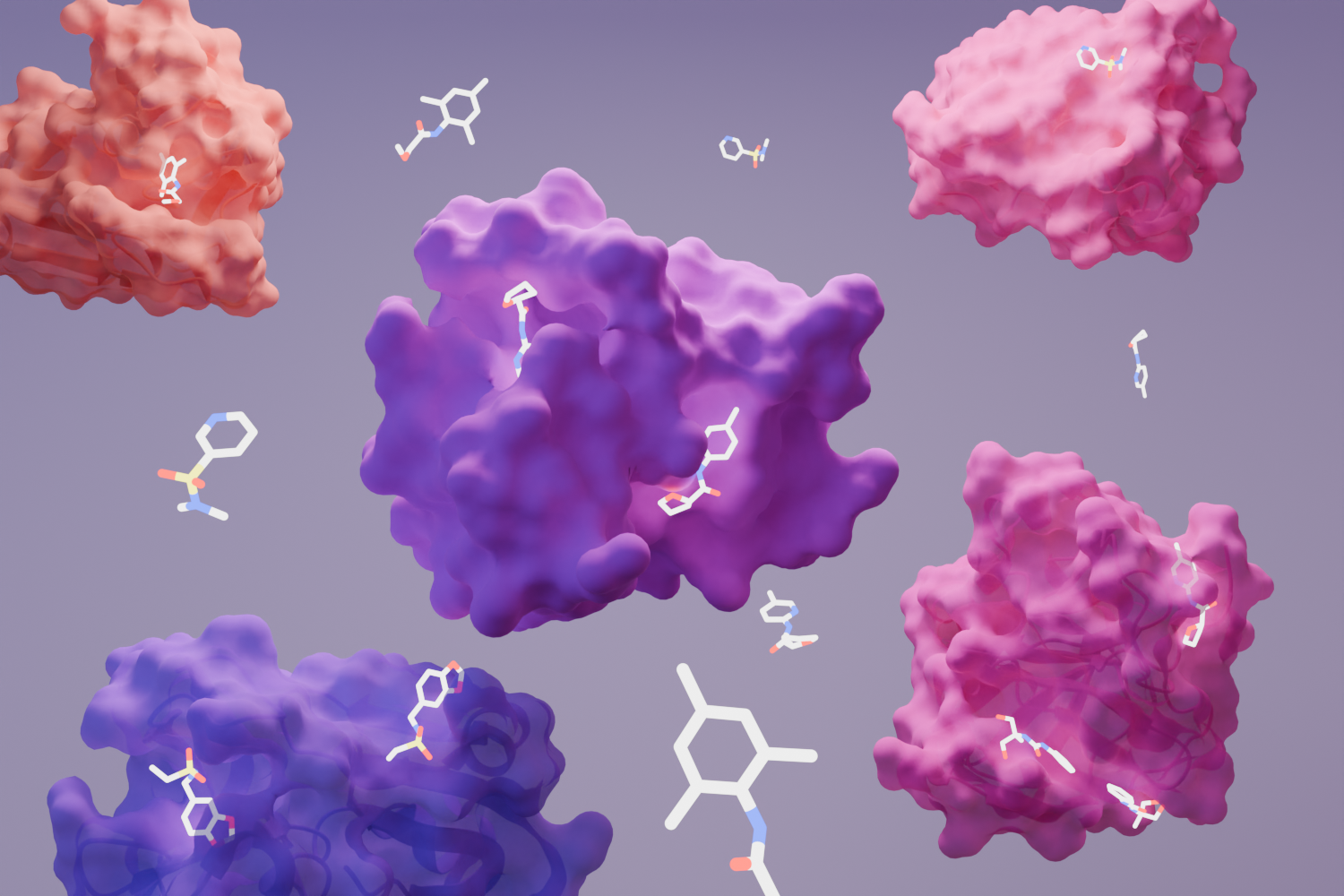
This challenge focuses on predicting how small molecules bind to the Zika virus NS2B-NS3 protease. We invite the molecular modelling community to predict protein–ligand complexes for 400 compounds, spanning small fragments to larger, lead-like molecules. Our aim is not simply to produce a leaderboard, but to understand where methods succeed, where they fail, and how they can be improved
The challenge opens on 14 October 2026, with final submissions due on 16 December 2026. Whether you develop docking methods, cofolding models, or workflows that combine different approaches, this is an opportunity to put your predictions to the test.
Key dates and how to join
Date
30 September 2026
14 October 2026
11 November 2026, 11.59pm UTC
16 December 2026, 11.59pm UTC
After 16 December 2026 Results
Milestone
Challenge announcement
Challenge launch
Interim leaderboard deadline
Final submission deadline
Results, webinars and wrap-up
Join the Blind Challenge Discord channel now!
The blind challenge will be hosted on Hugging Face via OpenADMET. Discord will be used for announcements, support, and Q&A.
Background: Zika virus NS2B-NS3 protease
Zika virus (ZIKV) belongs to the Flaviviridae family and is closely related to other flaviviruses such as dengue virus (DENV), West Nile virus (WNV), and Yellow Fever Virus (YFV).
ZIKV is primarily transmitted via mosquitoes. Most ZIKV infections are asymptomatic or cause mild illness. However, it can cause Guillain-Barré syndrome, neuropathy, and myelitis in adults and older children, while infection during pregnancy can cause microcephaly and other congenital abnormalities in newborns. In the 2015-2016 Zika virus epidemic alone, over a million people were infected, causing thousands of cases of infant microcephaly and other congenital brain abnormalities.
No licensed vaccine or antiviral therapy currently exists to prevent or treat ZIKV infection, making the development of effective interventions an important unmet need.
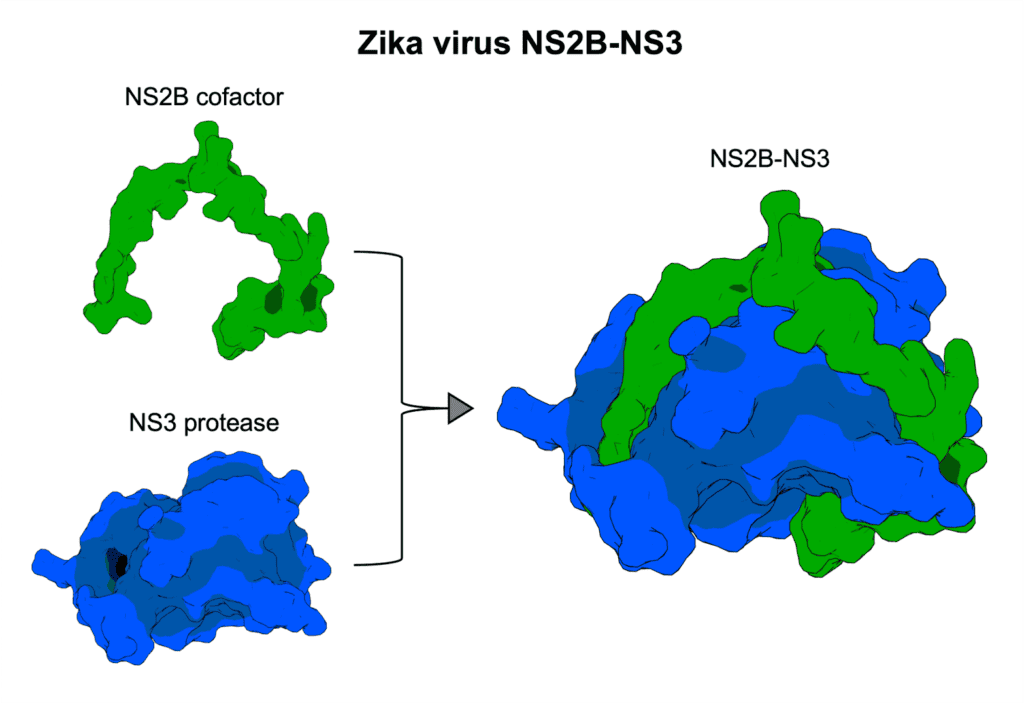
The ZIKV NS2B-NS3 protease is a target for antiviral discovery because it cleaves the viral polyprotein at several sites, an essential step in viral replication. The NS3 protease contains a serine, histidine, and aspartate as its catalytic triad in the active site, while part of NS2B wraps around the NS3 protease, acting as a cofactor and contributing to the protease active site and substrate recognition.
Structural studies have shown that the ZIKV NS2B-NS3 protease can adopt several conformations involving rearrangement of the NS2B cofactor: a closed conformation, an open conformation, and a super-open conformation. The open and super-open conformations are considered proteolytically inactive, as the C-terminal part of NS2B that contributes to the substrate-binding site is unstructured in these conformations.
Our focus has therefore been on the closed conformation of NS2B-NS3, using a bicistronic vector to co-express the NS2B cofactor and the NS3 protease. This optimised system gave us crystals in the P4322 space group with only one NS2B-NS3 complex in the asymmetric unit and an accessible active site, ideal for fragment screening and ligand soaking (PDB code: 29HN).
The Blind Challenge data
For this challenge, we soaked fragments from the EUbOpen DSiP extension and the Enamine Essential Fragments Libraries, follow-on compounds designed by the ASAP Discovery Consortium during the hit-to-lead phase of their discovery programme, and fragment analogues and follow-ups designed by OpenBind into ZIKV NS2B-NS3 crystals. The diffraction data were collected using unattended data collection at beamlines I03 and I04-1 at Diamond Light Source, UK. Data were automatically processed using in-house autoprocessing pipelines, and automatic binding event detection and ligand fitting were conducted using autoPanDDA and Pipedream. Ligand-binding sites were manually checked and further refined in the XChemExplorer environment. Read more about the experimental work here and here.
Challenge details
Participants will be provided with a FASTA file containing the amino acid sequences for the NS2B-NS3 construct and SMILES strings for 400 compounds, for which we have determined liganded ZIKV NS2B-NS3 structures using X-ray crystallography. Participants will be asked to submit their predicted protein-ligand complexes for each of the 400 ligands.
We have provided a representative apo structure for the optimised NS2B-NS3 system (PDB code: 29HN). Participants will not have access to the reference bound structures during the challenge. Previous studies (see example 1, example 2, example 3, or example 4) have released a number of bound and unbound structures for NS2B-NS3, which participants may use as they wish. The challenge therefore provides a blind test of predicting new protein–ligand complexes for a target with existing structural information.
How to participate
Participants should submit one protein–ligand complex for each of the 400 compounds, containing the required NS2B-NS3 protease construct and the predicted ligand pose.
Each predicted complex should be saved in PDB format using its supplied compound identifier (eg. blind challenge 001.pbd). Participants will need to package these PDB files in a single ZIP archive and upload it through the Submissions tab of the Hugging Face Space.
If you wish to be included in the final leaderboard, you must also submit a report summarising your methods. Participants must declare whether they used proprietary data and indicate the availability of code and model weights.
Further instructions, FAQs, and example submission and validation pipelines will be made available on the day of the challenge launch.
How predictions will be scored
Following the evaluation framework used in Runs N’ Poses and our previous OpenBind evaluations, predicted complexes will be evaluated using three complementary criteria: ligand pose accuracy, protein–ligand interface accuracy, and physical validity. For this challenge, a prediction will be considered successful only if it achieves ligand BiSyRMSD < 1.5 Å, lDDT-PLI > 0.8, and passes all PoseBusters validity checks.
- Ligand RMSD (BiSyRMSD): Binding-Site Superposed, Symmetry-Corrected Pose Root Mean Square Deviation (BiSyRMSD) measures how closely the predicted ligand pose matches the experimentally determined pose after aligning the protein binding sites and accounting for ligand symmetry. While a 2 Å RMSD threshold has commonly been used to define a correct ligand pose, we are adopting a more stringent cutoff of 1.5 Å. This has been used in several previous studies (e.g. here and here), particularly for high accuracy pose recovery or when assessing fragments, where a 2 Å displacement can be comparatively large.
- lDDT-PLI: Local Distance Difference Test for Protein Ligand Interactions (lDDT-PLI) measures the agreement in local protein–ligand interatomic distances between the prediction and the experimental reference, complementing the ligand-position information captured by RMSD.
- PoseBusters validity: Predictions must pass all PoseBusters checks for chemical and structural plausibility. These checks identify issues such as unrealistic ligand geometries, incorrect stereochemistry, and severe steric clashes that structural similarity metrics alone may miss.
The overall challenge score will be the fraction of complexes successfully predicted according to this definition, with missing or unevaluable predictions counting as failures. This success rate will determine the leaderboard ranking. Statistical significance of differences in performance will be evaluated using a procedure similar to that laid out in this article.
We will also report the average BiSyRMSD, lDDT-PLI, and PoseBusters pass rate over all structures to provide a more detailed picture of method performance and help distinguish between different modes of failure.
A live leaderboard on Hugging Face will report performance on approximately half of the compounds throughout the challenge. Performance on the full set, including those excluded from live leaderboard scoring, will determine the final leaderboard after submissions close. A one-off interim leaderboard based on the full set will be announced midway through the challenge. Participants should submit predictions for all compounds. During the challenge, participants will receive confirmation in the Discord channel that their submission has been successfully processed, together with information on any submission-format or validation failures.
Join the challenge
We invite researchers across computational chemistry, structural biology and machine learning to take part. Established methods, new models and carefully designed combinations of existing tools all have something to contribute.
After the challenge, we will discuss the results through webinars, blog posts, etc., looking beyond the aggregate rankings to examine the strengths and limitations of the submitted approaches.
Further instructions, FAQs, and example submission and validation pipelines will be made available on the day of the challenge launch.
Join us on 14 October for the blind challenge launch!
Acknowledgements
We would like to acknowledge the hard work of all the experimentalists scientists, and data wranglers at OpenBind for making this challenge possible. In addition, we would like to thank our collaborators at ASAP Discovery Consortium for providing us with compounds from their hit-to-lead phase against Zika NS2B-NS3 to use in this Blind Challenge. Many compounds in the blind challenge are derived from the medicinal chemistry campaign conducted by the ASAP Discovery Consortium and disclosed in this preprint. Some data featured in this challenge was generated by ASAP under NIH NIAID Antiviral Drug Discovery (AViDD) grant U19AI171399.
We also thank the beamline staff of beamlines I03 and I04-1 at Diamond Light Source for collecting the data under proposal lb42888. OpenBind received funding from the UK Department of Science, Innovation and Technology under grant number G2-SCH-2025-06-16537.
The OpenADMET team would like to thank Radial (part of the Astera Institute) for continuing support of our blind challenge efforts.